
Mercury represents thinking, communication, movement, and processing of information. This article helps you understand how your Mercury functions are influenced by whether Mercury was in retrograde or direct motion at the time of your birth. You will use your Mercury’s direct or retrograde motion to explore how you process ideas, communicate, and express your mental energy. You will complete an astro activity to identify one insight into your Mercury directionality and one action to support growth.
| Level | What You’ll Learn | What You Need to Know First | How to Use This Article |
|---|---|---|---|
| Beginner |
• What Mercury represents in astrology • How to blend Mercury symbolism with its direct or retrograde motion • How to reflect on your thinking and communication orientation |
• If your Mercury is direct or retrograde (from your natal chart) |
• Focus on the basic meanings of direct and retrograde • Follow the directions and example closely • Keep it simple and concrete |
| Intermediate |
• How Mercury’s direct or retrograde motion expresses itself across different ages • How Mercury’s natal orientation can change with maturity and life experiences |
• Awareness of your Mercury’s changes over time | • Reflect on how your natal Mercury’s direct or retrograde movement still impacts thinking and communication even as Mercury matures and changes over time |
| Advanced | • How progression charts add more information about the transformation of Mercury in a natal chart over time | • Awareness of Mercury’s changes over time and knowledge of progression charts |
• Think about the purpose of both retrograde and direct Mercury thinking • Consider how a change in Mercury’s directionality in a progression chart can impact how Mercury functions in the chart due to its new focus |
In Roman mythology, Mercury was the god of dexterity, commerce, travel, and communication, carrying messages between gods and humans. In Greek tradition, Hermes embodied similar qualities, known for his cleverness, quick wit, and ability to move between realms. In Mesopotamian astrology, Mercury was linked to Nabu, the god of writing and wisdom. Mercury’s role and characteristics are many, and they all work together to begin forming Mercury’s symbolism in astrology. Mercury’s nature is illustrated in this Greek myth.
When Hermes was still a baby, he slipped out of his cradle and wandered into the fields where he found Apollo’s sacred cattle. He decided to play a trick. He wanted to take the cows and make it untraceable. To accomplish this, he made the cows walk backward so their tracks looked reversed, and he wore sandals made from branches to hide his own footprints. Apollo soon noticed his herd was missing and stormed off to find the thief. When he confronted Hermes, the infant pretended to be innocent, lying sweetly in his cradle. Zeus laughed at the clever trick. To settle the quarrel, Hermes offered Apollo the lyre he had made from a tortoise shell. Apollo accepted the gift, and the two became friends — a story that shows Hermes’ quick wit, trickster nature, and gift for turning trouble and mischief into connection.
Themes emerge across these traditions: communication, trade, intellect, travel, and the duality of clarity versus trickery. These cultural meanings form the foundation for how astrology interprets Mercury in natal charts and in transit, especially during its retrograde periods, when its usual speed appears to reverse. During Mercury’s reversal (retrograde), in natal charts and in transits, delays can manifest in areas under Mercury’s domain, creating many invitations to think inwardly through pauses and reflection.
Mercury in astrology represents the way a person understands information, thinks, and speaks. Its placement by sign, house, and aspect shows how communication, learning, decision-making, and the exchange of ideas operate in daily life. These themes come from the mythic roles of Hermes and Mercury, who governed language, messages, trade, and movement. A Mercury in Gemini individual may show quick speech and curiosity, while Mercury in Capricorn may prefer structured thought, careful planning, and practical communication.
Mercury also describes how a person gathers information, how quickly they respond, and what kinds of mental environments feel natural. Some people think best through conversation, others through writing, and others through observation. Mercury’s sign can highlight whether someone prefers facts, impressions, patterns, or step-by-step logic. Its house placement shows where the mind is most active, such as relationships, work, home life, or creative expression. Aspects to Mercury reveal whether thinking is smooth, challenged, intensified, or made more complex by other planetary influences.
Retrograde Mercury in a natal chart often turns these functions inward. A person with natal Mercury retrograde may reflect deeply before speaking, revisit topics to understand them fully, or prefer to think through ideas privately before sharing them. They may excel at reviewing, editing, or reworking information because their mind naturally returns to material more than once. Direct Mercury, by contrast, tends to move information outward more quickly. These individuals often communicate in a straightforward way, express thoughts as they arise, and prefer clarity, efficiency, and momentum in conversations and decision-making.
In this article you are going to blend the meaning of the planet Mercury with how it moved (direct or retrograde) during the time of your birth. Blending symbolism in astrology is not limited to blending signs, planets, houses, and aspects. You also can use the planet’s movement, asteroids, midpoint calculations, and more. Beginner students should focus on Mercury retrograde for now, but keep in mind there is much more symbolism you can add to your readings as your skills grow.
Astrology students can deepen their understanding of Mercury by exploring whether their natal Mercury is retrograde or direct. This single detail often impacts how communication, thought, and information processing naturally flow through Mercury and whether the mind tends to move outward into expression or inward into reflection. When you blend Mercury’s sign, house, and aspects with its direction, you begin to see a more complete picture of how someone learns, speaks, listens, and interprets the world.
For example, Mercury in Leo usually expresses itself boldly and confidently, but if that Mercury is retrograde, the person may rehearse their ideas internally before sharing them or prefer to communicate through writing rather than spontaneous speech. Mercury in Virgo is analytical and detail-oriented, but when direct, it may communicate quickly and efficiently, while a retrograde Virgo Mercury may take extra time to refine thoughts, double-check information, or return to topics for deeper understanding. These differences are subtle but meaningful, and they help you understand not just what Mercury expresses, but how it expresses it.
If you do not know if your Mercury is direct or retrograde, calculate your natal chart using a free tool such as astro-seek.com. Enter your birth date, time, and location, and generate your chart. When you look at the planetary list, Mercury will appear with its sign and degree. If Mercury was retrograde at the time of your birth, you will see an “R” next to it. If there is no “R,” your Mercury is direct.
Once you know Mercury’s direction, you can begin blending. A direct Mercury often shows a more linear, outward flow, while a retrograde Mercury may show a reflective, looping, or inward flow. Adding this layer helps you understand why two people with the same Mercury sign can think and communicate in very different ways. It also helps you interpret how someone thinks under stress, how they learn best, and how they naturally express their ideas. This blending method gives you more nuanced and accurate reading, allowing you to see Mercury as a living, dynamic part of the chart rather than a single symbolic point.
Think about the planet Mercury and consider its key information. In your own words and examples explain what it means when Mercury is looking backward and inward when in retrograde versus when it looks ahead and outward when it is direct? Use the Insight and Action Astrology Learning Card below as a starting point.
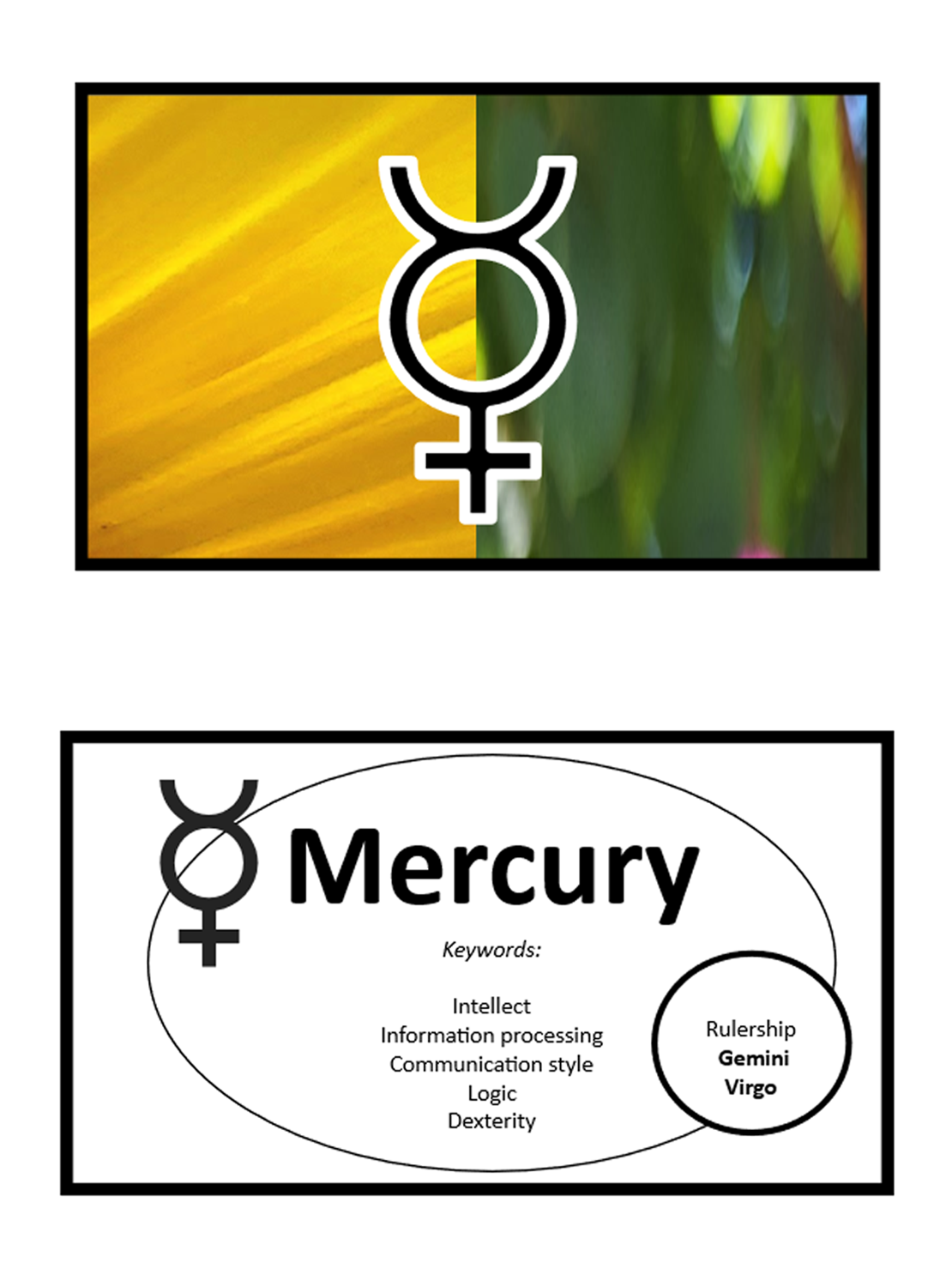
Blend what you know about the symbolism of Mercury (use your Mercury Card) with the meaning of a planet in retrograde or direct motion. Explore what this combination might mean in different situations that relate to Mercury’s energy.
Now reflect on your own natal Mercury’s motion: If your Mercury is retrograded, think about how you experience your inward flow. Do you find yourself revisiting ideas, editing thoughts before speaking, or discovering insights through reflection? How does this inward movement support your learning or creativity? If your Mercury is direct, consider how clarity and forward momentum shape your style. Do you prefer quick exchanges, fast learning, and moving on to new conversations? How does this outward movement help you share ideas or initiate action?
If your Mercury is direct, consider how you could step into the character of Mercury retrograde and experiment with revisiting ideas, editing thoughts before speaking, or discovering insights through an introspective orientation to support your growth from the inside.
If your Mercury is retrograde, consider how you could act more like a Mercury that is direct by working on increasing the clarity and forward momentum of your communication to support bringing your insights outward to share.
Insight & Action: Choose one insight about your Mercury. Then write one action you can take.
Examples: The next three times you communicate, you might:
• Focus on details, practicing patience in your communication or
• Focus on clearly responding without a deep dive and moving the communication forward
When reading a natal chart, it helps to consider both the original Mercury signature and how it may have developed across life stages. A retrograde Mercury in childhood may show up as hesitation, internal processing, or revisiting ideas repeatedly, but in adulthood it may become a strength for deep thinking, editing, or insight-based communication. A direct Mercury may begin as fast, outward expression and later mature into clarity, leadership, or confident articulation. By blending Mercury’s natal condition with your lived experience, you can see how your communication style has grown, where it still follows its original pattern, and how Mercury’s motion continues to shape your thinking and expression over time.
How has your communication style changed as you have grown older, and how does Mercury’s retrograde or direct motion impact the meaning and timing of those changes?
When Mercury changes direction in progression — for example, moving from retrograde to direct or from direct to retrograde — it can mark a significant turning point in how come to and express your ideas. Thinking and communicating both inwardly and outwardly are necessary for growth. Analyzing progressions can help you see how Mercury energy evolves throughout your life. What impact does a change in directionality have when seen in a progression chart? How does the timing of the Mercury motion change its meaning in the progression chart? Before answering the reflection question, make sure to calculate your progression chart and study Mercury’s placement and motion in your progression chart.
How has your progressed Mercury’s direction and its change, or the lack of change, shaped the way you think, communicate, and understand yourself at different stages of life?
Adding in Details
Looking at the motion of a planet is one of the many details that, as you continue to study and practice astrology, you can apply to your analysis. There are many other details, asteroids, midpoints, and various ways of calculating charts, to use to learn about the same charts but in new ways. The beautiful thing about astrology is the ability to learn from each new symbol you apply or method you use. In this article we explored Mercury’s motion and this inward or outward focus can be applied to the motions of all of the planets. This activity is an example of how even seemingly small symbolic details can add to the depth and complexity of the reading of a chart.
Continue exploring your natal chart and upcoming articles that highlight planetary meanings and methods to help you learn about yourself and the universe.
Astrology grows through both self-study and shared wisdom. Articles, cards, and booklets guide study and reflection, and community, mentorship, and classes deepen practice. Your path can be personal and collective, shaped by your own insights and the insights of others. The Insight and Action Astrology Natal Astrology Learning Cards and Foundation Booklet provide a step-by-step framework and much of the information shared in this article series comes from the design of that resource. Some activities and information in the article series will overlap with the cards and booklet work, and some will be unique to the article. Use the articles andInsight and Action Astrology Natal Astrology Learning Cards and Foundation Booklet together for extra enrichment, activities, examples, and support.